Few automotive brands ignite the imagination like Lamborghini. The raging bull emblem, the thunderous exhaust note, and the razor-sharp silhouettes have made Lamborghini synonymous with extreme performance, bold design, and unapologetic luxury since 1963. From challenging Ferrari on home turf to pioneering hybrid supercars in the 2020s, the Sant’Agata Bolognese marque has never played it safe. Today, in 2026, Lamborghini stands as a global symbol of automotive excellence, blending heritage with cutting-edge electrification while staying true to its rebellious spirit.
The story begins with Ferruccio Lamborghini, a self-made industrialist born in 1916. After building a fortune manufacturing tractors from wartime scrap and later air conditioners, Ferruccio grew frustrated with his Ferrari’s mechanical shortcomings. Legend claims Enzo Ferrari dismissed him as “just a tractor maker,” prompting Ferruccio to launch his own sports car company. On May 7, 1963, Automobili Lamborghini was founded in a modest factory near Bologna. The goal: create refined grand tourers that outperformed the competition in comfort and reliability.
The first production model arrived in 1964—the 350 GT. Powered by a 3.5-liter V12 designed by Giotto Bizzarrini, it offered 280 hp and elegant coachwork by Touring. But the real revolution came in 1966 with the Miura. Styled by Marcello Gandini at Bertone, the Miura was the world’s first mid-engine supercar. Its transverse V12 produced 350 hp, propelling it beyond 170 mph. Low-slung, curvaceous, and wildly exotic, the Miura redefined what a sports car could be and instantly made Lamborghini a household name among the elite.
The 1970s amplified the drama. The Countach, unveiled in 1971 and produced from 1974, introduced the world to the “wedge” design and scissor doors. Its aggressive lines, massive rear wing options, and evolving V12 engines—from 4.0 to 5.2 liters—pushed power past 450 hp in Quattrovalvole form. The Countach became an icon of 1980s excess, starring in posters, movies, and dreams worldwide. Other milestones included the Espada (1968), the first true four-seater V12, and the LM002 (1986), an early high-performance off-roader that foreshadowed today’s SUVs.
Ownership turbulence followed. Ferruccio sold the company in 1972. Chrysler took control in 1987, producing the Diablo in 1990—a 202-mph monster that briefly held the title of fastest production car. After brief Malaysian-Indonesian ownership, Audi (Volkswagen Group) acquired Lamborghini in 1998, bringing engineering rigor and financial stability without diluting the brand’s soul.
The new millennium exploded with creativity. The Murciélago (2001) revived the V12 flagship with 572 hp. The Gallardo (2003) introduced a more accessible V10 and became Lamborghini’s best-seller, with over 14,000 units produced. The Aventador (2011) raised the bar with a 6.5-liter V12 delivering 700 hp and scissor doors as standard. The Huracán (2014) refined the formula with a 5.2-liter V10, advanced aerodynamics, and variants like the track-focused STO.
In 2018 Lamborghini shocked the industry with the Urus—the first “Super SUV.” Powered by a 4.0-liter twin-turbo V8, it combined 641 hp supercar acceleration (0-62 mph in 3.6 seconds) with genuine off-road capability and luxury. It quickly became the company’s volume leader, proving Lamborghini could dominate multiple segments.
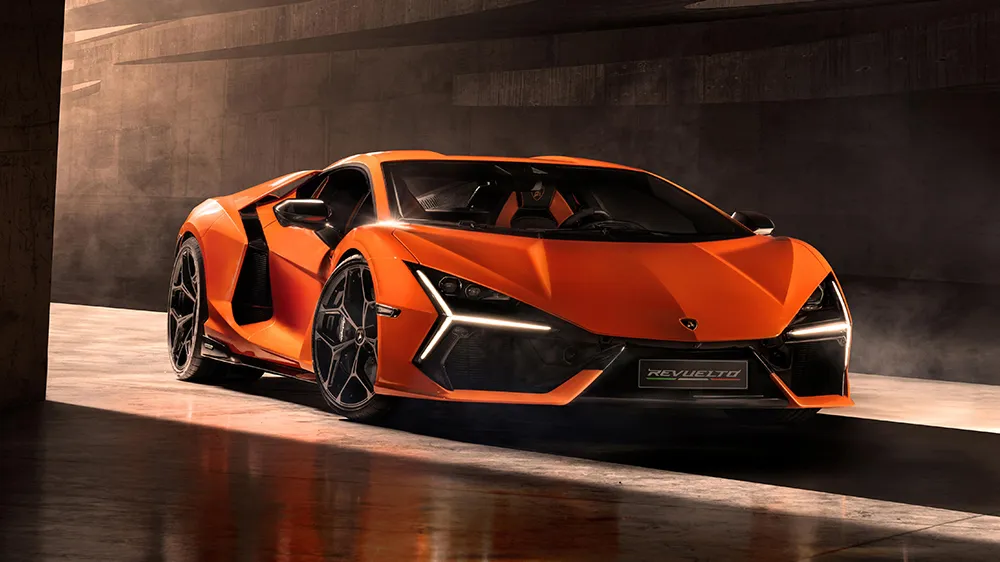
By 2026, the brand has fully embraced hybridization under the “Direzione Cor Tauri” roadmap, targeting full electrification by 2030 while preserving emotional driving thrills. The Revuelto, launched in 2023 as the Aventador successor, is Lamborghini’s first High Performance Electrified Vehicle (HPEV). Its re-engineered 6.5-liter V12—now rotated 180 degrees—delivers 825 hp alone, paired with three electric motors for a combined 1,015 CV (roughly 1,001 hp). It sprints 0-100 km/h in 2.5 seconds, exceeds 350 km/h, and features active aero, four-wheel steering, and a revolutionary carbon-fiber chassis. The cabin blends digital interfaces with tactile leather and carbon fiber, offering both comfort and race-car intensity.
Hot on its heels is the Temerario, the Huracán replacement. This compact supercar swaps the V10 for a clean-sheet 4.0-liter twin-turbo V8 producing 800 hp, augmented by three electric motors for 920 CV total. It achieves 0-100 km/h in 2.7 seconds and 343 km/h top speed, with superior torque delivery and an intoxicating soundtrack. Lamborghini claims the new powertrain exceeds the Huracán’s driving emotion while meeting stricter emissions rules.
The Urus lineup remains dominant. The Urus SE plug-in hybrid combines a 620-hp V8 with a 192-hp electric motor for 800 CV, 0-100 km/h in 3.4 seconds, and 312 km/h. It offers short EV-only range alongside blistering performance. The Urus S delivers pure V8 fury at 666 CV. Together, these models ensure Lamborghini’s DNA—bold styling, explosive acceleration, and daily usability—thrives across segments.
Design remains central to the brand’s identity. Sharp hexagonal motifs, aggressive Y-shaped headlights, and names drawn from fighting bulls (Revuelto, Temerario) keep the aesthetic ferocious. Interiors feature Alcantara, forged composites, and customizable options that make each car unique. Engineering highlights include push-rod suspension, adaptive dampers, and massive carbon-ceramic brakes.
Beyond the road, Lamborghini Squadra Corse runs successful one-make Super Trofeo series and GT3 programs, transferring technology to production cars. Limited editions like the 2026 Fenomeno (just 29 units, hybrid V12 hypercar) continue the tradition of exclusivity.
Culturally, Lamborghini transcends automotive circles. Countachs starred in The Wolf of Wall Street; Murciélagos tore through The Transporter. Celebrities, athletes, and billionaires flock to the brand. In video games and social media, Lamborghinis represent ultimate success.
As Lamborghini approaches its 65th anniversary in 2028, the future looks electrifying yet faithful to its roots. The raging bull has evolved from tractors to hybrids without losing its roar. In an era of sustainability, Lamborghini proves performance and passion can coexist. Whether slicing through mountain passes in a Revuelto or dominating highways in an Urus SE, these machines deliver pure adrenaline.
Lamborghini isn’t merely a car—it’s an attitude. A declaration that life should be lived at full throttle. For enthusiasts worldwide, the bull continues to charge forward, reminding us why we fell in love with cars in the first place.